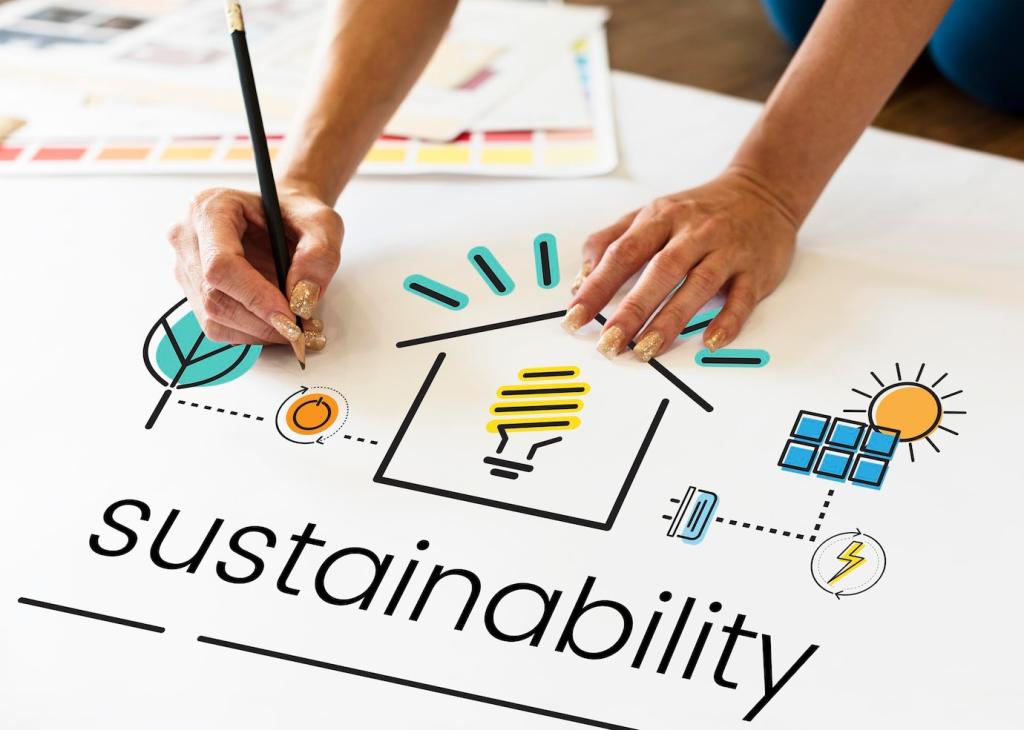

Build Better: Best Practices for Implementing Sustainable Design

Chosen theme: Best Practices for Implementing Sustainable Design. Welcome! This home page is your field guide to making sustainability practical, inspiring, and measurable. Explore proven methods, real stories, and tools you can use today—and join our community by subscribing and sharing your experiences.

Start with Purpose and Systems Thinking

Set specific, time-bound targets like EUI reduction, embodied carbon per square meter, water use per occupant, and waste diversion rates. One studio pinned a sticky note reading “Cut EUI by 45%” above every workstation; months later, that reminder shaped hundreds of small choices that collectively beat the target.

Start with Purpose and Systems Thinking

Trace impacts across sourcing, construction, operations, maintenance, and end-of-life. Invite users, facility managers, and suppliers early. On a school retrofit, a custodian’s note about nightly cleaning schedules led to smarter ventilation controls, saving energy without sacrificing healthy air—insight no model would have predicted alone.

Start with Purpose and Systems Thinking

A clear narrative—who benefits, what changes, and why it matters—keeps teams aligned when trade-offs arise. One housing project framed its story around lower energy bills for families; that lens protected passive strategies during value engineering. What’s your north star? Share it and inspire someone else’s next decision.

Start with Purpose and Systems Thinking

Lorem ipsum dolor sit amet, consectetur adipiscing elit. Ut elit tellus, luctus nec ullamcorper mattis, pulvinar dapibus leo.


Material Choices and Circularity

Use EPDs and HPDs, avoid Red List chemicals, and favor FSC wood, recycled metals, and low-carbon concrete with supplementary cementitious materials. A daycare switched to linoleum and mineral-based paints, and teachers reported fewer headaches within weeks—proof that health-forward choices pay off immediately.

Material Choices and Circularity

Specify reversible connections, standardized modules, and material passports. A pop-up pavilion was bolted—not glued—so it could be rebuilt annually with minimal waste. Over three seasons, components were reconfigured for new programs, saving costs and teaching hundreds of visitors what circular design looks and feels like.

Optimize orientation and envelope performance

Model solar exposure, glazing ratios, and shading to tame loads before buying equipment. Tighter air-sealing and reduced thermal bridges often outperform fancy tech. A small clinic rotated nine degrees to catch winter sun and added exterior shades; heating and cooling loads dropped dramatically without changing the HVAC type.

Pair efficient systems with renewables

Right-size heat pumps, add heat recovery ventilation, and commission controls before installing photovoltaic arrays. A café upgraded to a variable-refrigerant system and tuned schedules; when rooftop solar finally came, bills fell so far the owner started hosting workshops on energy literacy for neighboring businesses.

Measure, verify, and adjust continuously

Submeter key end uses, set baselines, and run post-occupancy evaluations. An office dashboard flagged overnight plug loads; a simple policy and a few smart strips saved more energy than the original lighting retrofit. Commissioning is not a milestone—it’s an ongoing habit that builds momentum.
Combine rainwater capture, greywater reuse, and low-flow fixtures with drought-tolerant planting. An arts center routed roof runoff into cisterns feeding irrigation and toilets; during a dry summer, operations stayed smooth and utility managers asked for the specs to inform a citywide conservation guide.

Tools, Metrics, and Certification

Compare assemblies with life cycle assessment, coordinate takeoffs in BIM, and simulate daylight, comfort, and energy scenarios before committing. A team swapped a slab detail after LCA showed a hidden carbon hotspot; costs held steady, and the project’s embodied emissions dropped noticeably.
Oilodevks
Privacy Overview

This website uses cookies so that we can provide you with the best user experience possible. Cookie information is stored in your browser and performs functions such as recognising you when you return to our website and helping our team to understand which sections of the website you find most interesting and useful.